With the arrival of the 21st century, marked by convergence, the Korean Bible Society’s Institute for Bible Translation Research merged and re-organized the Bible Translation Department, the Institute for Biblical Text Research, and the Library for Biblical Studies in order to strengthen connections with scholars in Korea and abroad, and to further solidify its role as a central hub for the translation and revision of the Bible. To this end, the Institute will broaden understanding of the original biblical texts and their translations through interdisciplinary exchange, and will compile diverse perspectives of Korean churches and accumulate research.
In addition, the Institute will research the theory and practice of Bible translation worldwide in collaboration with the United Bible Societies and national Bible Societies, raise public interest and awareness of Bible translation using various media, and continue to develop Bible content digitally and a Bible translation database.
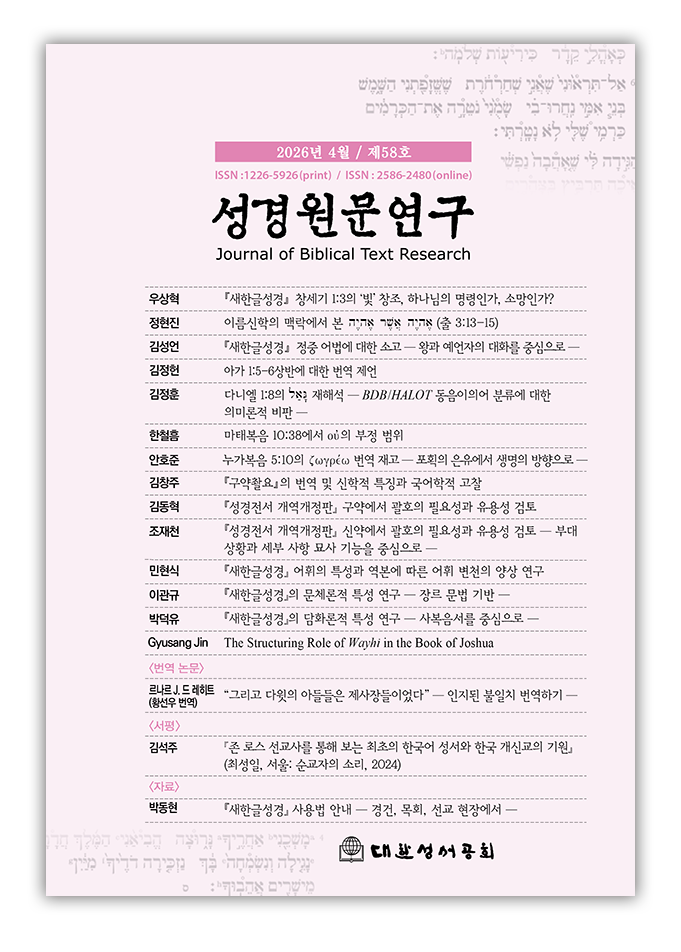
In particular, the Institute publishes a bi-annual journal specializing in biblical studies entitled the Journal of Biblical Text Research (JBTR), which has been indexed by the National Research Foundation of Korea (NRF) since December 29, 2010.
The JBTR publishes academic researches on biblical languages like Hebrew, Aramaic, and Greek and languages related to ancient translations as well as research findings on biblical hermeneutics, history of biblical texts, biblical manuscripts, and Bible translation by scholars in Korea and abroad. The journal also examines the New Korean Revised Version (1998), the Revised Common Translation (1999), the Revised New Korean Standard Version (2001), and the New Korean Translation (2024) published by KBS, identifying areas for improvement and compiling resources to be reflected in future revisions or new translations. It also introduces global trends in Bible translation theory and practice through cooperation with the United Bible Societies.
Areas of Interest
1) Biblical Languages and Related Classical Languages
Research biblical languages like Hebrew, Aramaic, and Greek and languages related to ancient translation including Arabic, Ethiopic, Latin, Syriac, Coptic, Armenian, Georgian, Slavonic, etc in order to accumulate resources for Bible translation research.
2) Biblical Studies for Bible Translation
Research across the full spectrum of biblical scholarship—biblical theology, biblical interpretation, manuscript studies, biblical geography, biblical history, textual history, biblical archaeology, and ancient Near Eastern studies—to incorporate the latest scholarly findings into new translations and revisions.
3) Review and Study of Existing Korean Bible Versions
Continue to review early Korean Bible translations and the authorized versions published by the Korean Bible Society to date to accumulate research that can be reflected in future translation projects.
4) Bible Translation Studies
Introduce latest global trends in Bible translation theory in cooperation with the United Bible Societies and sister Bible societies in the US, Germany, the Netherlands, etc and facilitate their use in Bible translation and revision research.
5) Bible Translation and General Linguistics
Research in general linguistics as well as sociolinguistics, cognitive linguistics, etc to contribute to Bible translation and revision.
6) Bible Translation and Korean Linguistics
Research phonological, lexical, syntactic, and semantic systems, history, education, policy, etc of the Korean language to apply the findings to Bible translation and revision.
7) Computing Technology for Bible Translation
Maintain proficiency in the latest version of Paratext, the Bible translation software developed by the United Bible Societies and make optimal use of Bible Translation Database maintained by the Institute for Bible translation and revision. Preparing for publication of print and digital editions upon the completion of any translation or revision.
8) Development of Resources for Bible Engagement
Develop resources helping readers use and engage with newly translated or revised Bible versions for personal devotion and church life such as congregational worship, education, mission activities, and Sunday schools.